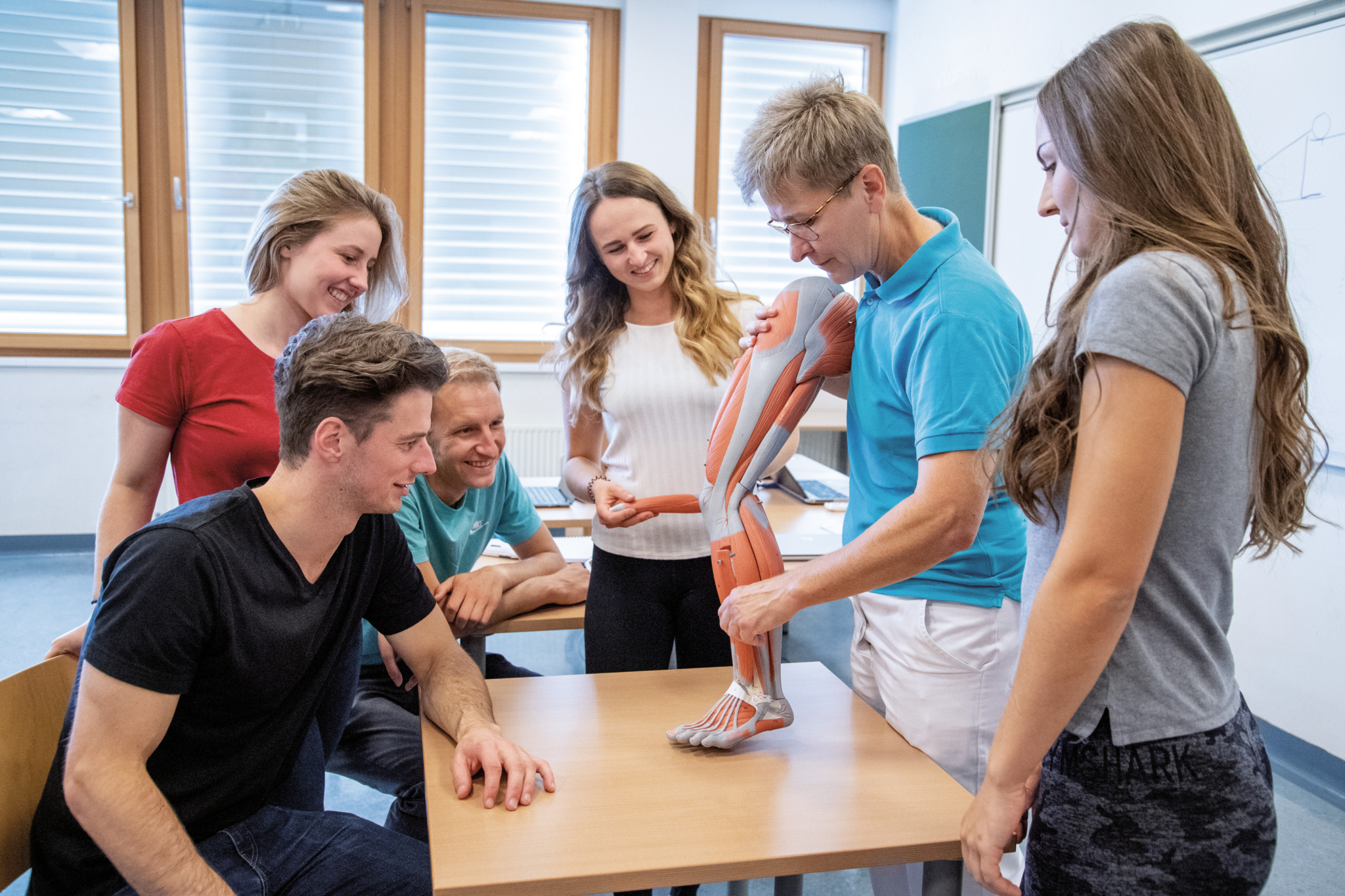
Physiotherapy

Specific physiology 1 The student -can differentiate between the physiological functions of sensory perceptions. -is able to differentiate the physiological functions of the nervous system. -can differentiate between the physiological functions of the musculature. -is able to create a synthesis between the physiological functions of the sensory perceptions, the nervous system and the musculature.Specific anatomy The student -can explain the structure, functioning and interaction of bones, joints, blood vessels, muscles and the nervous system.Anatomy in vivo The student -can determine the topographical position of palpable structures on the musculoskeletal system. -can differentially palpate the bony, muscular, ligamentous and neural structures and vessels using the appropriate techniques. -can assess the palpated structures relevant for physio-therapeutic examination and treatment.
- Semester:
- 1
- Type:
- Integrated course compulsory course
- ECTS-points:
- 3
- Contents:
- -Palpation techniques
-Topography of palpable structures on the musculoskeletal system
-Targeted palpation of bony, muscular, ligamentous and neural structures and vessels
-Differentiation and assessment of structures relevant for physiotherapeutic examination and treatment
- Semester:
- 1
- Type:
- Integrated course compulsory course
- ECTS-points:
- 3
- Contents:
- -Origin, attachment, function, innervation of the musculature
-Joints and how they work
-Neuroanatomy
-Vascular system
- Semester:
- 1
- Type:
- Integrated course compulsory course
- ECTS-points:
- 1,5
- Contents:
- -Sensory physiology
-Physiology of the nervous system
-Muscle physiology
Specific physiology 2 The student -can differentiate the physiology of specific connective tissues. -is able to differentiate between the physiological adapta-tions to different types of physical work. -can differentiate between the physiological functions of the organs. -is able to differentiate the wound healing of specific tissu-es of the musculoskeletal system. -can differentiate between the physiology of different ty-pes of pain. -is able to describe the physiological development of the human organism.
- Semester:
- 2
- Type:
- Integrated course compulsory course
- ECTS-points:
- 5,5
- Contents:
- -Connective tissue physiology of specific tissues of the
musculoskeletal system
-Performance physiology
-Organ physiology
-Wound healing of specific tissues of the musculoskeletal system
-Pain physiology and pain mechanisms
-Developmental physiology
Physical medicine and rehabilitation The student -can explain the basics and tasks of physical medicine and rehabilitation, their diagnostics, methods and measures as well as their areas of application.Orthopaedic traumatology The student -can explain the medical examination and treatment plan in the clinical field of orthopaedic traumatology. -can assign the existing symptoms to the corresponding clinical pictures and recognise complications.Neurology The student -can explain the medical examination and treatment plan in the clinical field of neurology. -can assign the pathophysiological development mechanisms of symptoms and signs to the clinical pictures and recognise complications.
- Semester:
- 2
- Type:
- Lecture compulsory course
- ECTS-points:
- 1,5
- Contents:
- Cause, symptoms, course, pathophysiology, medical diagnos-tics and conservative/surgical therapy for:
-Insult
-Craniocerebral trauma
-Brain tumour
-Parkinson's disease
-Multiple sclerosis
-Cross section
-Polyneuropathy
-peripheral nerve lesions
and for other neurological diseases
- Semester:
- 2
- Type:
- Lecture compulsory course
- ECTS-points:
- 2,5
- Contents:
- Cause, symptoms, course, pathophysiology, medical diagnos-tics and conservative/surgical therapy for:
-congenital structural changes
-traumatic and atraumatic structural changes
and for other selected pathologies.
- Semester:
- 2
- Type:
- Lecture compulsory course
- ECTS-points:
- 0,5
- Contents:
- -Basics of physical medicine and rehabilitation
-Mode of action, indications, contraindications of physical diagnostics and therapy measures
Internal medicine The student -can explain the medical examination and treatment plan in the clinical area of internal medicine. -can assign the existing symptoms to the corresponding clinical pictures and recognise complications.Surgery The student -can explain the medical examination and treatment plan in the clinical area of surgery. -can assign the existing symptoms to the corresponding clinical pictures and recognise complications.
- Semester:
- 3
- Type:
- Lecture compulsory course
- ECTS-points:
- 1
- Contents:
- -Cause, symptoms, course, pathophysiology, medical diagnostics and conservative/surgical therapy for:
-Heart, lung and vascular surgery
-Abdominal surgery
-Amputations
-Breast surgery
and for other surgical procedures
- Semester:
- 3
- Type:
- Lecture compulsory course
- ECTS-points:
- 1
- Contents:
- Cause, symptoms, course, pathophysiology, medical diagnos-tics and conservative/surgical therapy for:
-Pregnancy/weaning bed
-for pelvic floor insufficiency
-after spontaneous labour (incl. perineal injuries)
-after cesarean section
-after gynaecological, urological and proctological operations
-Countersinks incl. pessaries
-Endometriosis
-Lichen sclerosus
-Prostate cancer (in which compartment would this fit)
-Bowel surgery incl. stoma
-Urinary incontinence
and for other selected gynaecological, urological and proctolog-ical diseases and pathologies from this specialist area.
- Semester:
- 3
- Type:
- Lecture compulsory course
- ECTS-points:
- 2,5
- Contents:
- Cause, symptoms, course, pathophysiology, medical diagnostics and conservative/surgical therapy for:
-Obstructive and restrictive lung diseases such as bronchial asthma, COPD and pulmonary fibrosis
-Bronchial carcinoma
-Long COVID / post-Covid syndrome
-Diseases of the endocrine system such as diabetes mellitus, obesity, metabolic syndrome, kidney disease and dialysis
-Diseases of the cardiovascular system such as CHD, heart failure, myocardial infarction, cardiac arrhythmia and hypertension
-Vascular diseases such as orthostatic dysregulation, chronic venous insufficiency, PAD, thrombosis and post-thrombotic syndrome
-Bed Rest Syndrome
-Post-hospital syndrome
-Multimorbidity
and for other internal diseases
- Semester:
- 3
- Type:
- Lecture compulsory course
- ECTS-points:
- 1
- Contents:
- Cause, symptoms, course, pathophysiology, medical diagnostics and conservative/surgical therapy for:
-Disorders of the peripheral and central nervous system
-Neuromuscular diseases
-Malformations of the musculoskeletal system
-Organ malformations/dysfunctions
and for other selected pathologies in childhood and adolescence.
- Semester:
- 3
- Type:
- Lecture compulsory course
- ECTS-points:
- 1
- Contents:
- Cause, symptoms, course, pathophysiology, medical diagnos-tics and conservative/surgical therapy for:
-Schizophrenia
-Affective disorders
-Neurotic disorders
-Stress disorders
-Somatoform disorders
-Behavioural problems in connection with physical disorders
-Personality disorders
and for other selected psychiatric and psychosomatic illnesses.
Intensive care medicine The student -can explain the medical examination and treatment plan in the clinical area of intensive care medicine. -can assign the existing symptoms to the corresponding clinical pictures and recognise complications.Geriatrics The student -can explain the medical examination and treatment plan in the clinical area of geriatrics. -can assign the existing symptoms to the corresponding clinical pictures and recognise complications.
- Semester:
- 4
- Type:
- Lecture compulsory course
- ECTS-points:
- 1
- Contents:
- Cause, symptoms, course, pathophysiology, medical diagnostics and conservative/surgical therapy for:
-gerontological clinical pictures
-gerontopsychiatric clinical pictures
-age-specific changes
and other selected geriatric diseases.
- Semester:
- 4
- Type:
- Lecture compulsory course
- ECTS-points:
- 0,5
- Contents:
- Cause, symptoms, course, pathophysiology, medical diagnostics and conservative/surgical therapy for:
-for patients with different types of invasive and non-invasive ventilation and monitoring
-Transit syndromes
and other selected intensive care diseases and pathologies.
General anatomy and physiology The student -knows the morphological and functional relationships of the healthy body. -is familiar with medical terminology. -has basic knowledge of the development and structure of the human organism. -knows the basics of physiology. -explains the function of organ systems and their interaction.General pathology The student -has knowledge about the development of diseases. -knows about the causes and effects of deviating cell and tissue structures and functions in the organism.Hygiene The student -knows standards of hygiene, infection prevention and epidemiology and derive prophylactic measures from these. -takes the requirements of hygiene into account and recognises the importance of hygiene in the healthcare sector.Health promotion and prevention in the healthcare professions The student -explains the basic concepts of health promotion, resilience, health literacy, climate literacy, health literacy and prevention within and outside its own division. -describes the importance of health-promoting measures both for themselves personally and for their clients/patients. -knows the basic principle of primary care in Austria and its tasks in connection with public health and health promotion.Emergency management The student -recognises life-threatening conditions and provides the appropriate first aid. -creates the basic monitoring and interprets these basic values. -Carries out initial measures in airway management.Legal bases 1 and healthcare The student -knows the job profiles and areas of expertise of the healthcare professions in Austria. -recognises the limits of independent professional practice and makes reference to the relevant legal regulations. -knows the organisational structures and political spheres of influence of the Austrian healthcare system as well as the basic principles of hospital management.Digitisation The student -can explain selected basic terms from the field of digitalisation in healthcare. -can explain selected information systems in the healthcare sector.
- Semester:
- 1
- Type:
- Lecture compulsory course
- ECTS-points:
- 4
- Contents:
- -Basics of anatomy and physiology including terminology
-Biology of the cell, tissue types incl. functions
-Respiratory system
-Cardiovascular system
-Digestive system and metabolism
-Kidneys and urinary tract
-Skeletal system and musculoskeletal system
-Reproductive system incl. reproductive organs
-Nervous and endocrine system
-Skin and sensory organs
-Blood, immune system and lymphatic organs
- Semester:
- 1
- Type:
- Lecture compulsory course
- ECTS-points:
- 1,5
- Contents:
- -Definition, basics and tasks of pathology
-Pathogenesis and pathophysiology of diseases
-Epidemiology and prevention of diseases
-Cell growth and differentiation
-Cell and tissue damage
-Inflammatory pathology
-Immunopathology
-Basic concepts of genetics and heredity
-Systemic pathology
- Semester:
- 1
- Type:
- Lecture compulsory course
- ECTS-points:
- 0,5
- Contents:
- -Definition of digitalisation in the healthcare context
-eHealth - definition of terms and areas of application (e.g. health telematics, telemedicine ...)
-Digital interfaces in healthcare facilities (e.g. HIS, LIS, RIS2, SAP, ...)
-Current applications
- Semester:
- 1
- Type:
- Integrated course compulsory course
- ECTS-points:
- 0,5
- Contents:
- -Basics and definitions of terms
-Examples from practice (good practice)
-Importance of health promotion and prevention for healthcare professionals, for clients/patients, for the healthcare system and for the economy.
-International and national developments in health promotion and health policy (nutrition, exercise, substance abuse such as alcohol, nicotine, drugs, ...)
-Age and gender aspects and forms of communication in health promotion
- Semester:
- 1
- Type:
- Lecture compulsory course
- ECTS-points:
- 0,5
- Contents:
- -Rough concept for hospital hygiene
-Basic concepts of epidemiology/pathogen ty-pes/infectiology/disinfection/sterilisation
-Waste disposal in hospitals
-Hand hygiene and personal hygiene
-Immunisation
-Healthcare associated infections
- Semester:
- 1
- Type:
- Integrated course compulsory course
- ECTS-points:
- 0,5
- Contents:
- -Basic Life Support (BLS) based on the European Resuscita-tion Council (ERC) Guidelines
-Aspiration events/bolus events - with special attention to the management of the airway
-Paediatric emergencies
-xABCDE scheme
-Customer Relationship Management (CRM) guidelines
-Basic monitoring
-Alerting the cardiac alarm team or MET team (algorithm)
-Sim training with feedback (see CAS model)
-Practical exercises in small groups
-Reflection models/methods after stressful events
- Semester:
- 1
- Type:
- Lecture compulsory course
- ECTS-points:
- 1
- Contents:
- -Job profiles and areas of expertise in the healthcare sector
•Pharmacist: Pharmacy Act
•Physician: Medical Act
•Higher medical-technical service: Medical-Technical Services Act (biomedical analyst, dietician, occupational therapist, speech therapist, orthoptist, physiotherapist, radiological technologist)
•Healthcare and Nursing: Healthcare and Nursing Act (Higher Service for Healthcare and Nursing, Nursing Assistant, Nursing Assistant)
•Midwife: Midwives Act
•Cardiotechnician: Cardiotechnician Act
•Masseur: Medical Masseur and Therapeutic Massage Act
•Medical assistant professions: Medical Assistance Professions Act (disinfection assistant, plaster assistant, laboratory assistant, autopsy assistant, operating theatre assistant, surgery assistant, X-ray assistant, training therapist (sports scientist), new: surgical assistant)
•Music therapist: Music Therapy Act
•Psychologist: Psychology law
•Psychotherapist: Psychotherapy Act
•Rescue and ambulance service: Paramedics Act
•Dentist, dental assistant and prophylaxis assistant: Dentists Act
-Austrian healthcare system and basic principles of hospital management
•Organisation of authorities and distribution of tasks in Austria:
Relationship between federal government - provinces - district administration - social insurance
•Health structure plan
•Austrian social security system: health, accident and pension insurance
•Excursus:
•Tax-financed model, e.g. Great Britain, NHS or private insurance system, e.g. USA - "Obamacare"
•Fundamentals and models of hospital financing: LKF model and DRG model
•Operational and strategic controlling Key figures: Case numbers, bed utilisation, patient flows, recording of services, ...
Basics of quality and data management The student -explains the basics of data and quality management in the healthcare sector. -analyses and applies documentation standards in the various settings, reflects on them and supports quality-related activities (e.g. interface management, quality reporting, outcome quality measurement).Legal basis 2 The student -knows and understands the basic principles of the legal foundations and laws specific to the profession. -knows and understands the relevant job-specific aspects of data security.Family and patient education The student -knows the basics of professional information and counselling sessions. -recognises the importance of a basis of trust with clients/patients and their relatives. -knows the relevant professional laws and the competences and responsibilities they contain.Digital healthcare and teletherapeutic concepts The student -recognises the potential applications of digital healthcare and teletherapeutic concepts. -analyses the digital treatment concepts in the context of digital transformation. -understands initiating change processes. -develops a reflective attitude.
- Semester:
- 3
- Type:
- Lecture compulsory course
- ECTS-points:
- 0,5
- Contents:
- -Definitions of terms (eHealth, telemedicine, telehealth, digital health)
-General
•Megatrends and challenges in the healthcare sector
•Telemedicine: Framework conditions in Austria/Germany
•Systems, technical framework conditions
•Goals, benefits and opportunities as well as challenges, obstacles and limitations
•Quality assurance
•Legal basis
•Examples from practice
•Teletherapy concepts
•Strategies e.g. televisits, examples of implementation
•Examples of digital health projects (e.g. in the GGZ geriatric health centre in Graz, interactive training systems, ...)
-Methods and applications of digital healthcare, e.g:
•Assissitve technologies
•Digital health applications (DIGAS)
•Digital care applications (DiPA)
•Mobile health applications (apps)
•Wearables (fitness watches, etc.)
•Gamification
•AR/VR systems,
•Robotics
•Smart Health/ Home
•Web-based platforms (for HP)
•Artificial Intelligence (AI), Artificial Intelligence (AI)
•Movement laboratory, ...
- Semester:
- 3
- Type:
- Lecture compulsory course
- ECTS-points:
- 0,5
- Contents:
- -Framework conditions for patient education
-Legal framework (professional laws, competences, responsibilities)
-Concepts of health promotion/health education and its connection with family and patient education
(Salutogenetic model according to Antonovsky, empowerment, model of behavioural change e.g. according to Prohaska and DiClemente, the terms health literacy/health promotion/prevention)
-Terms family, psycho- and patient education with the methods of patient education (information, training, counselling, moderation)
-Goals of client/patient and family education (compliance, adherence, consulting, counselling)
-Phases of the education process
-Use of aids for client/patient and family education (evaluation of brochures, information materials, videos, ... using the Witten list or the SAM evaluation scheme; dealing with sources)
-Information transfer
-Prerequisites and framework conditions for successful educational processes (target group orientation, proximity/distance, challenges such as the influence of stress situations/knowledge/language/cultural barriers, ...)
-Aspects of person-centred conversation and questioning techniques
-Differences between the methods "informing", "counselling" and "training" with examples (interprofessional)
-Interprofessional client/patient and family education
- Semester:
- 3
- Type:
- Lecture compulsory course
- ECTS-points:
- 1
- Contents:
- -Basics of data management
-Basics and terms of quality management
-Quality assurance and development measures
-Application of digitalisation concepts in the healthcare sector on the basis of legal framework conditions
- Semester:
- 3
- Type:
- Lecture compulsory course
- ECTS-points:
- 0,5
- Contents:
- -Profession-specific legal principles and laws
•Liability (criminal liability, civil liability)
•Patient rights, exemplary (patient charter, e.g. Upper Austria, adult protection law, living will law, dying will law)
•Special regulations relevant to the profession (hospital law, e.g. hospital hygiene based on §8a KAKuG, medical device law, pharmaceutical law, accommodation law, right to stay in a nursing home, ...)
-Data protection and security
•Art 1 DSG: Fundamental right to data protection
•GDPR: relevant provisions
•Professional rights (right to confidentiality and data protection, explicit consent, handling of personal data, duty of confidentiality)
Physiotherapy in health promotion and prevention The student -can explain the basic principles of health promotion and prevention. -is able to describe the role of physiotherapy in health promotion and prevention. -can develop exercise-promoting measures as part of health promotion and prevention projects. -is able to apply the physiotherapy process in health promotion and prevention
- Semester:
- 2
- Type:
- Integrated course compulsory course
- ECTS-points:
- 1
- Contents:
- -Project management in health promotion and prevention
-Basics of health promotion and prevention
-Fields of activity and tasks in physiotherapy
-Measures to promote exercise and maintain health
-Physiotherapeutic process in health promotion and pre-vention
Movement theory and biomechanics The student -can identify deviations in posture and movement on the basis of physiological principles. -is able to practically analyse posture and movement. -can document the results of the posture and movement analysis. -is able to instruct posture and movement. -can transfer the physical principles of mechanics and dy-namics to the human organism. -is able to practically apply biomechanical measurement procedures as part of the physiotherapy process.Motor learning and self-awareness The student -can explain the basics of motor learning and the physiolo-gical process of sensory development. -is able to recognise deviations from physiological develo-pment parameters. -can recognise deviations from physiological posture and movement in themselves and others.
- Semester:
- 1
- Type:
- Integrated course compulsory course
- ECTS-points:
- 3
- Contents:
- -Prerequisite for posture and movement
-Posture and movement analysis
-Description, documentation and instruction of posture and movement
-Applied biomechanics
-Biomechanical methods of dynamometry and kinemetry
- Semester:
- 1
- Type:
- Integrated course compulsory course
- ECTS-points:
- 2
- Contents:
- -Basics of motor learning
-Course of normal sensorimotor development
-Recognising typical developmental parameters in healthy individuals and deviations from them
-Self-awareness of deviations in physiological posture and movement.
The student -can defend the Bachelor's thesis and reflect on the scientific findings generated in the process -is able to demonstrate a physiotherapy process using a simulated case study
- Semester:
- 6
- Type:
- Final Exam compulsory course
- ECTS-points:
- 2
- Contents:
- Examination interview includes:
-Defence of the Bachelor thesis
-Physiotherapy process based on a simulated case study
The student -can explain the basic terms and their meaning in occupational medicine, physiology and psychology. -is able to explain legal requirements relevant to occupational medicine. -can describe the physiotherapeutic fields of activity in occupational medicine. -can provide an overview of interprofessional collaboration in occupational medicine. -is able to carry out a workplace and activity analysis.
- Semester:
- 5
- Type:
- Integrated course compulsory course
- ECTS-points:
- 1
- Contents:
- -Fundamentals of occupational medicine, work physiology and psychology
-Legal basis and occupational diseases
-Interprofessional team and fields of activity in occupational medicine
-Workplace and activity analysis
Multimodal pain management The student -can explain neurophysiological models of pain management. -is able to describe the pathophysiology of nociception and pain processing. -can assign suitable prevention measures in relation to pain chronification on a case-by-case basis. -is able to select suitable physiotherapeutic measures for pain treatment on a case-by-case basis. -can carry out suitable procedures for assessment and pro-gress documentation. -is able to take cultural and gender-related influencing fac-tors into account when implementing the physiotherapeutic process in the context of pain treatment.Manual lymphatic drainage The student -can apply CDT taking into account relevant indications and contraindications. -can perform MLD on the healthy lymphatic system practically on selected areas of the body. -can practically implement the lymphatic bandage on the arm and leg.
- Semester:
- 5
- Type:
- Integrated course compulsory course
- ECTS-points:
- 2
- Contents:
- Structure, function, tasks and pathologies of the lymphatic sys-tem:
-Lymphostasis, Stemmer signs + significance, complications of lymphoedema, oedema classification according to Födli, causes of insufficiencies, lymphoedema classification (deve-lopment, characteristics, treatment)
- Indications and contraindications Complex physical decon-gestive therapy
- Practical implementation Manual lymph drainage + bandaging + lymph tape
- Semester:
- 5
- Type:
- Integrated course compulsory course
- ECTS-points:
- 1
- Contents:
- -Pain mechanisms
-Pathophysiology of nociception and pain processing
-Prevention of chronification
-Physiotherapeutic interventions for musculoskeletal pain
-Test procedure for assessing and documenting the course of pain
-Cultural and gender-related differences in pain behaviour
The student -can implement the physiotherapy process in relation to planning, implementation, evaluation, documentation and reflection in the specialist area of surgery on the basis of the relevant clinical content using case studies. -can take contraindications and warnings into account when planning and carrying out the physiotherapy process. -can practically implement the examination and treatment techniques as part of the physiotherapy process in the speciality of surgery in an exemplary manner.
- Semester:
- 4
- Type:
- Integrated course compulsory course
- ECTS-points:
- 1
- Contents:
- Physiotherapeutic process for
-Heart, lung and vascular surgery
-Abdominal surgery
-Amputations
-Breast surgery
and other selected surgical procedures
The student -can implement the physiotherapy process in relation to planning, implementation, evaluation, documentation and reflection in the specialist area of geriatrics on the basis of the relevant clinical content using case studies. -can take contraindications and warnings into account when planning and carrying out the physiotherapy process. -can practically implement the examination and treatment techniques as part of the physiotherapy process in the speciality of geriatrics in an exemplary manner.
- Semester:
- 4
- Type:
- Integrated course compulsory course
- ECTS-points:
- 1,5
- Contents:
- Physiotherapeutic process for
- gerontological clinical pictures
- gerontopsychiatric clinical pictures
- age-specific changes
with special attention to immobility, multimorbidity, increased risk of falls
-specific assessments, such as: DEMMI, TUG, balance tests, FallsEfficacy Scale
and other gerontological and psychiatric diseases and pathologies
The student -can implement the physiotherapy process in terms of planning, implementation, evaluation, documentation and reflection in the specialist area of gynaecology/urology/proctology on the basis of the relevant clinical content using case studies. -can take contraindications and warnings into account when planning and carrying out the physiotherapy process. -can practically implement the examination and treatment techniques as part of the physiotherapy process in the specialist area of gynaecology/urology/proctology in an exemplary manner.
- Semester:
- 4
- Type:
- Integrated course compulsory course
- ECTS-points:
- 1
- Contents:
- Physiotherapeutic process for
-Pregnancy/weaning bed
-Pelvic floor insufficiency
-Urinary and faecal incontinence
-Endometriosis
-Lichen sclerosus
-Prostate carcinoma
-Bowel surgery incl. stoma
and other gynaecological/urological/proctological clinical pictures
The student -can implement the physiotherapy process in terms of planning, implementation, evaluation, documentation and reflection in the specialist area of intensive care medicine on the basis of the relevant clinical content using case studies. -can take contraindications and warnings into account when planning and carrying out the physiotherapy process. -can practically implement the examination and treatment techniques as part of the physiotherapy process in the specialist area of intensive care medicine.
- Semester:
- 4
- Type:
- Integrated course compulsory course
- ECTS-points:
- 1
- Contents:
- Physiotherapeutic process for
-Patients with different types of invasive and non-invasive ventilation and monitoring
-Transit syndromes
and other intensive care diseases and pathologies
The student -can implement the physiotherapy process in terms of planning, implementation, evaluation, documentation and reflection in the specialist area of internal medicine on the basis of the relevant clinical content using case studies. -can take contraindications and warnings into account when planning and carrying out the physiotherapy process. -can practically implement the examination and treatment techniques as part of the physiotherapy process in the specialism of internal medicine in an exemplary manner.
- Semester:
- 4
- Type:
- Integrated course compulsory course
- ECTS-points:
- 3,5
- Contents:
- Physiotherapeutic process for
-Obstructive and restrictive lung diseases such as bronchial asthma, COPD and pulmonary fibrosis
-Bronchial carcinoma
-Long COVID / post-Covid syndrome
-Diseases of the endocrine system such as diabetes mellitus, obesity, metabolic syndrome, kidney disease and dialysis
-Diseases of the cardiovascular system such as CHD, heart failure, myocardial infarction, cardiac arrhythmia and hypertension
-Vascular diseases such as orthostatic dysregulation, chronic venous insufficiency, PAD, thrombosis and post-thrombotic syndrome
-Bed Rest Syndrome
-Post-hospital syndrome
-Multimorbidity
and other selected diseases and pathologies
The student -can implement the physiotherapy process in terms of planning, implementation, evaluation, documentation and reflection in the field of neurology on the basis of the relevant clinical content using case studies. -can take contraindications and warnings into account when planning and carrying out the physiotherapy process. -can practically implement examination and treatment techniques as part of the physiotherapy process in the specialism of neurology in an exemplary manner.
- Semester:
- 3
- Type:
- Integrated course compulsory course
- ECTS-points:
- 4
- Contents:
- Physiotherapeutic process for
Insult, traumatic brain injury, brain tumours, Parkinson's disease and Huntington's disease
The student -can implement the physiotherapy process in terms of planning, implementation, evaluation, documentation and reflection in the field of neurology on the basis of the relevant clinical content using case studies. -can take contraindications and warnings into account when planning and carrying out the physiotherapy process. -can practically implement the examination and treatment techniques as part of the physiotherapy process in the specialism of neurology in an exemplary manner.
- Semester:
- 4
- Type:
- Integrated course compulsory course
- ECTS-points:
- 4
- Contents:
- Physiotherapeutic process for multiple sclerosis, spinal cord injury, polyneuropathy, amyotrophic lateral sclerosis, Guillain Barre, myasthenia gravis, myotonia and myasthenia.
peripheral nerve lesions
The student -can implement the physiotherapy process in relation to planning, implementation, evaluation, documentation and reflection in the field of oncology on the basis of the rele-vant clinical content using case studies. -can take contraindications and warnings into account when planning and carrying out the physiotherapy process. -can practically implement examination and treatment techniques as part of the physiotherapy process in the speciality of oncology in an exemplary manner.
- Semester:
- 5
- Type:
- Integrated course compulsory course
- ECTS-points:
- 0,5
- Contents:
- -Epidemiology, antitumour therapies and systemic therapies including side effects and relevant training methods
-Exercise therapy for oncological patients in rehabilitation, during and after antitumour therapy
-Barriers/facilitators for exercise and exercise therapy in oncology
The student -can implement the physiotherapy process in terms of planning, implementation, evaluation, documentation and reflection in the field of orthopaedic traumatology on the basis of the relevant clinical content using case studies. -can take contraindications and warnings into account when planning and carrying out the physiotherapy process. -can practically implement the examination and treatment techniques as part of the physiotherapy process in the specialist area of orthopaedic traumatology in an exemplary manner.
- Semester:
- 3
- Type:
- Integrated course compulsory course
- ECTS-points:
- 6
- Contents:
- Physiotherapeutic process for selected capsulo-ligamentous, muscular, tendinous, chondral, bony and neural pathologies in the trunk, lumbar spine, pelvis and lower extremity regions
The student -can implement the physiotherapy process in terms of planning, implementation, evaluation, documentation and reflection in the field of orthopaedic traumatology on the basis of the relevant clinical content using case studies. -can take contraindications and warnings into account when planning and carrying out the physiotherapy process. -can practically implement the examination and treatment techniques as part of the physiotherapy process in the specialism of orthopaedic traumatology in an exemplary manner.
- Semester:
- 4
- Type:
- Integrated course compulsory course
- ECTS-points:
- 5,5
- Contents:
- Physiotherapeutic process for selected capsulo-ligamentous, muscular, tendinous, chondral, bony and neural pathologies in the upper extremities, the trunk and thorax regions as well as the thoracic and cervical spine
The student -can implement the physiotherapy process in terms of planning, implementation, evaluation, documentation and reflection in the field of paediatrics on the basis of the relevant clinical content using case studies. -can take contraindications and warnings into account when planning and carrying out the physiotherapy process. -can practically implement examination and treatment techniques as part of the physiotherapy process in the specialist area of paediatrics in an exemplary manner.
- Semester:
- 4
- Type:
- Integrated course compulsory course
- ECTS-points:
- 1
- Contents:
- Physiotherapeutic process for
-Disorders of the peripheral and central nervous system
-Neuromuscular diseases
-Malformations of the musculoskeletal system
-Organ malformations/dysfunctions
and other diseases and pathologies in childhood and adolescence.
The student - can implement the physiotherapy process in relation to planning, implementation, evaluation, documentation and reflection in the specialist area of palliative medicine on the basis of the relevant clinical content using case studies. - can take contraindications and warnings into account when planning and carrying out the physiotherapy process. - can practically implement examination and treatment techniques as part of the physiotherapy process in the specialist area of palliative medicine.
- Semester:
- 5
- Type:
- Integrated course compulsory course
- ECTS-points:
- 0,5
- Contents:
- -Symptoms, dysfunctions and needs of seriously ill and dying people
-Special features of the physiotherapy process for seriously ill and dying patients
-Strategies for personal mental hygiene
-Mourning models
The student -can implement the physiotherapy process in terms of planning, implementation, evaluation, documentation and reflection in the specialist area of psychiatry and psychosomatics on the basis of the relevant clinical content using case studies. -can take contraindications and warnings into account when planning and carrying out the physiotherapy process. -can practically implement examination and treatment techniques as part of the physiotherapy process in an exemplary manner in the field of psychiatry and psychosomatics.
- Semester:
- 4
- Type:
- Integrated course compulsory course
- ECTS-points:
- 1
- Contents:
- Physiotherapeutic process for
-selected constructed case studies from the areas of schizophrenia, affective disorders, neurotic, stress and somatoform disorders, behavioural problems in connection with physical disorders, personality disorders
PT Process Basics The student -can categorise the corresponding models in the respective parts of the physiotherapy process. -can implement adequate communication with people within the physiotherapy process. -has an awareness of professional, economic and ecological values for the implementation of the physiotherapy process.Professional profile, professional duties and professional ethics The student -can explain the importance of the legal basis for vocational training and practice. -can explain the functions of regional, national and international professional interest groups. -can explain which occupational groups can carry out activities under physiotherapeutic supervision. -can describe the current occupational profile and its development.Applied hygiene The student -can implement current hygiene regulations and stan-dards, as well as infection prevention measures, in the physiotherapy work environment. -has internalised the importance of individual responsibility with regard to personal and professional hygiene. -is able to carry out standardised hygiene measures in the physiotherapy work environment under supervision.
- Semester:
- 1
- Type:
- Integrated course compulsory course
- ECTS-points:
- 0,5
- Contents:
- -Practical implementation of infection prevention mea-sures in the professional environment of physiotherapy
-Hygiene measures in the workplace
- Semester:
- 1
- Type:
- Integrated course compulsory course
- ECTS-points:
- 0,5
- Contents:
- -Legal foundations of the profession and training, e.g. MTD Act, FH - MTD - AV, FhStg.
-Professional duty according to §11
-Job profile and fields of activity
-Regional, national and international interest groups
-Delegating physiotherapy activities to other professional groups.
-Job profile and development of the profession at a glance
- Semester:
- 1
- Type:
- Integrated course compulsory course
- ECTS-points:
- 2
- Contents:
- -Components and structure of the PT process
-Integration of various models such as
Bio-psycho-social model
ICF
Clinical Reasoning
Salutogenesis
EBP
-Conducting dialogue as part of the physiotherapy process
-Professional, economic and ecological principles/values
PT Process Deepening The student -can link the corresponding models with the respective parts of the physiotherapy process. -can identify red and yellow flags as part of the physiotherapy process.Case-based learning 1 The student -can carry out the physiotherapy process under guidance with targeted assistance using constructed case studies. -demonstrates a willingness to act in accordance with professional, economic and ecological values when carrying out the physiotherapy process.
- Semester:
- 2
- Type:
- Practice-oriented session compulsory course
- ECTS-points:
- 1,5
- Contents:
- -Implementation of the PT process with repetitions ac-cording to instructions using case simulations.
- Semester:
- 2
- Type:
- Integrated course compulsory course
- ECTS-points:
- 0,5
- Contents:
- -Deepening the PT process
-Basic principles of red/yellow flag screening
The student -can carry out the physiotherapy process with guidance using constructed case studies. -is committed to applying professional, economic and ecological values when carrying out the physiotherapy process.
- Semester:
- 3
- Type:
- Practice-oriented session compulsory course
- ECTS-points:
- 1
- Contents:
- -Implementation of the PT process using case simulations under guidance
-Consideration of professional, economic and ecological principles and/or values
Supervised patient management The student -can carry out the physiotherapy process in a team under supervision using simulated case studies. -can practically implement examination and treatment techniques as part of the physiotherapy process using simulated case studies.Case-based learning 3 The student -can critically scrutinise their own implementation of the PT process in simulated case studies. -can weigh up the professional, economic and ecological values when carrying out the physiotherapy process in simulated case studies.
- Semester:
- 4
- Type:
- Practice-oriented session compulsory course
- ECTS-points:
- 2
- Contents:
- -Reflection on the supervised case simulation
-Value organisation
- Semester:
- 4
- Type:
- Integrated course compulsory course
- ECTS-points:
- 1
- Contents:
- Carrying out a PT process using a case simulation under supervision
The student -can critically scrutinise own implementations of the PT process. -can weigh up the professional, economic and ecological values when carrying out the physiotherapy process.
- Semester:
- 5
- Type:
- Practice-oriented session compulsory course
- ECTS-points:
- 1
- Contents:
- Reflection of the
-Training protocols from the internship
-Organisation of different
The student -can critically scrutinise own implementations of the PT process. -can weigh up the professional, economic and ecological values when carrying out the physiotherapy process.
- Semester:
- 6
- Type:
- Practice-oriented session compulsory course
- ECTS-points:
- 1
- Contents:
- Reflection of the
-Training protocols from the internship
-Organisation of different values
Examination and treatment in physiotherapy 1 The student -can explain the basic examinations and treatments based on the ICF. -is able to carry out basic examinations and treatments on the basis of the ICF. -can explain the prophylaxis on a structural and functional level. -is able to carry out prophylaxis at a structural and functional level. -can explain the use and possible applications of aids. -is able to use aids in a patient-adapted manner.
- Semester:
- 1
- Type:
- Integrated course compulsory course
- ECTS-points:
- 4
- Contents:
- -Basic examination and treatment based on the ICF
-Prophylaxis at the structural and functional level
-Supply and use of aids
Examination and treatment in physiotherapy 2 The student -based on the physiotherapeutic process, can carry out hypothesis-led specific examination techniques, taking into account the contraindications, on the lower extremities, pelvis and thorax as well as on the lumbar and thoracic spine, based on the principles of the ICF. -is able to interpret and document the available case-based examination results on the lower extremities, pelvis and thorax as well as on the lumbar and thoracic spine. -can derive suitable treatment measures, taking into account the contraindications in the area of the lower extremities, pelvis and thorax as well as the lumbar and thoracic spine -can perform examination and treatment techniques on the lower extremities, pelvis and thorax as well as on the lumbar and thoracic spine in a manner appropriate to the situation and patient. -shows an adapted interaction with the person being treated as part of the physiotherapy examination and treatment.Physical therapy The student -can apply the principles of physical medicine and rehabilitation to diagnosis and treatment in an exemplary manner. -can take contraindications and warnings into account during diagnosis and treatment. -can practically implement diagnostics and treatment based on the fundamentals of physical medicine and rehabilitation using case studies.
- Semester:
- 2
- Type:
- Integrated course compulsory course
- ECTS-points:
- 1,5
- Contents:
- -Electrotherapy
-Classic massage
-Underwater therapy
-Precautionary measures and special features of the prac-tical patient-adapted implementation of the individual di-agnostic and therapeutic procedures from the areas:
-High, medium and low frequency therapy
-Light therapy
-Ultrasound
-Thermotherapy
-Hydrotherapy
-Balneotherapy
- Semester:
- 2
- Type:
- Integrated course compulsory course
- ECTS-points:
- 7,5
- Contents:
- -Hypothesis-led examination techniques on the lower ext-remities, pelvis and thorax as well as on the lumbar and thoracic spine based on the ICF
-Contraindications and effectiveness of examination tech-niques and treatment measures on the lower extremities, pelvis and thorax as well as the lumbar and thoracic spine
-Case-based implementation of examination techniques and treatment measures on the lower extremities, pelvis and thorax as well as the lumbar and thoracic spine
-Situation- and patient-adapted practical implementation of examination techniques and treatment measures
-Adequate patient interaction
Examination and treatment in physiotherapy 3 The student -can carry out hypothesis-led specific examination techniques on the upper extremities and cervical spine based on the principles of the ICF, taking into account contraindications and building on the physiotherapy process. -is able to interpret and document the available case-based examination results on the upper extremities and the cervical spine. -can derive suitable treatment measures, taking into account the contraindications in the area of the upper extremities and the cervical spine -can perform examination and treatment techniques on the upper extremities and cervical spine in a manner appropriate to the situation and patient. -shows an adapted interaction with the person being treated as part of the physiotherapy examination and treatment.Reflex zone therapy The student -can explain the neurophysiological models of reflexology. -can give an overview of the most commonly used methods of reflexology and describe their indications and contraindications. -can explain the treatment procedure of a selected method of reflexology. -can practically apply selected measures from reflexology.
- Semester:
- 3
- Type:
- Integrated course compulsory course
- ECTS-points:
- 0,5
- Contents:
- -Neurophysiological explanatory models of reflex therapy
-Overview of the various methods of reflexology and their indications and contraindications
-Implementation of selected measures.
- Semester:
- 3
- Type:
- Integrated course compulsory course
- ECTS-points:
- 4,5
- Contents:
- -Hypothesis-led examination techniques on the upper extremities and cervical spine based on the ICF
-Contraindications and effectiveness of examination techniques and treatment measures on the upper extremities and the cervical spine
- Case-based implementation of examination techniques and treatment measures on the upper extremities and cervical spine
-Situation- and patient-adapted practical implementation of examination techniques and treatment measures
-Examination and treatment of pain
-Adequate patient interaction
The student -can present the in-depth and/or extended content based on the chosen physiotherapy specialisation. -is able to apply deepening and/or expanding practical skills and abilities on the basis of the chosen physiotherapy spe-cialisation.
- Semester:
- 6
- Type:
- Integrated course compulsory optional subject
- ECTS-points:
- 1
- Contents:
- Advanced and/or in-depth knowledge and skills in the field of digitalisation
- Semester:
- 6
- Type:
- Integrated course compulsory optional subject
- ECTS-points:
- 1
- Contents:
- Extended and/or in-depth knowledge and skills in the field of education in physiotherapy
- Semester:
- 6
- Type:
- Integrated course compulsory optional subject
- ECTS-points:
- 1
- Contents:
- Expanded and/or deepened knowledge and/or competences by attending a specialist congress
- Semester:
- 6
- Type:
- Integrated course compulsory optional subject
- ECTS-points:
- 1
- Contents:
- Extended and/or in-depth knowledge and skills in the field of cardiorespiratory physiotherapy
- Semester:
- 6
- Type:
- Integrated course compulsory optional subject
- ECTS-points:
- 1
- Contents:
- Extended and/or in-depth knowledge and skills in the field of life-phase-orientated physiotherapy
- Semester:
- 6
- Type:
- Integrated course compulsory optional subject
- ECTS-points:
- 1
- Contents:
- Advanced and/or in-depth knowledge and skills in the field of musculoskeletal physiotherapy
- Semester:
- 6
- Type:
- Integrated course compulsory optional subject
- ECTS-points:
- 1
- Contents:
- Extended and/or in-depth knowledge and skills in the field of neurorehabilitation
- Semester:
- 6
- Type:
- Integrated course compulsory optional subject
- ECTS-points:
- 1
- Contents:
- Extended and/or in-depth knowledge and skills in the field of sports physiotherapy
- Semester:
- 6
- Type:
- Integrated course compulsory optional subject
- ECTS-points:
- 1
- Contents:
- Extended and/or in-depth knowledge and skills in the field of animal-assisted physiotherapy
The student -Can develop mono- or interdisciplinary physiotherapy health promotion and prevention projects taking into ac-count the evidence. -can implement measures in mono- or interdisciplinary physiotherapy health promotion and prevention projects, taking into account the evidence. -can evaluate mono- or interdisciplinary physiotherapy health promotion and prevention projects taking into ac-count the evidence.
- Semester:
- 6
- Type:
- Integrated course compulsory course
- ECTS-points:
- 0,5
- Contents:
- -Development, implementation and evaluation of mono- and interdisciplinary physiotherapeutic health promotion and prevention projects, taking into account the evidence
The student -applies technologies in the healthcare sector, taking into account a critical analysis. -recognises the responsibility of other healthcare and other professions and works in a multi-professional team. -analyses the public impact of one's own behaviour in everyday professional life. -develops health literacy, i.e. the ability to find, understand, evaluate and apply health information in order to make appropriate health decisions in everyday life. -integrates target group-specific climate communication in stakeholder -transfers own decisions responsibly to the outside world. -possesses social-communicative and self-competences, in particular the ability to communicate, criticise and deal with conflict, as well as empathy, frustration tolerance, role distance, self-determination and self-reflection. -recognises a professional self-image for the practice of the profession and the ability to actively shape and participate in everyday professional life.
- Semester:
- 3
- Type:
- Integrated course compulsory course
- ECTS-points:
- 1
- Contents:
- -Deepening the topic of interprofessionalism
-Effectiveness of the healthcare professions in the public eye
-Best practice example of interprofessional casework
-Workshops on various interprofessional case studies
- Semester:
- 3
- Type:
- Integrated course compulsory course
- ECTS-points:
- 0,5
- Contents:
- -Explanation of terms (mono-, multi- and interprofessionalism with all dimensions and gradations)
-In-depth examination of the job profiles
-Status of healthcare professions in the public/society and oppor-tunities to exert influence
-Best practice example of interprofessional casework
-Importance of climate expertise in the healthcare professions
- Semester:
- 3
- Type:
- Integrated course compulsory optional subject
- ECTS-points:
- 0,5
- Contents:
- •Perception as a person with own strengths and weaknesses - Self-marketing skills (resilience factor - self-efficacy)
•Positive, goal-orientated and productive thinking and action - Constructive lifestyle (resilience factor - responsibility)
•Consideration and acceptance of thoughts, feelings and the world view of others - Empathy (resilience factor - network orientation)
•Consideration and acceptance of the individuality of people and groups in interactions - Knowledge of human nature (resilience factor - responsibility)
•Appreciative and appropriate behaviour in one's own and foreign cultural context - Intra-/intercultural competence (resilience factor - responsibility)
- Semester:
- 3
- Type:
- Integrated course compulsory optional subject
- ECTS-points:
- 0,5
- Contents:
- •Perception as a person with their own strengths and weaknesses - Self-marketing skills (resilience factor - self-efficacy)
•Willingness to define own professional interests and to derive points of view as well as negotiation goals and lim-its - Negotiation skills
•Planning and controlling your own time management - (resilience factor personal responsibility)
•Planning own and external activities - both interprofes-sional and patient/client-centred;
- Semester:
- 3
- Type:
- Integrated course compulsory optional subject
- ECTS-points:
- 0,5
- Contents:
- •Acceptance of the impact of one's own thoughts and ac-tions on the professional environment - systemic thinking
•Planning and controlling your own time management - (resilience factor personal responsibility)
•Self and external motivation - motivational capacity - (re-silience factor self-efficacy)
•Argumentative persuasion in conversations, interactions and communicative disputes - Persuasiveness / argumen-tation skills
- Semester:
- 3
- Type:
- Integrated course compulsory optional subject
- ECTS-points:
- 0,5
- Contents:
- •Acceptance of the impact of one's own thoughts and ac-tions on the professional environment - systemic thinking
•Decision-making by weighing up and comparing alterna-tive courses of action according to objective criteria - de-cision-making competence
•Appreciative and appropriate constructive criticism behav-iour - Critical competence (resilience - taking personal re-sponsibility, leaving the role of victim)
•Recognising, accepting and resolving conflicts and seeing them as an opportunity for change - conflict competence
- Semester:
- 3
- Type:
- Integrated course compulsory optional subject
- ECTS-points:
- 0,5
- Contents:
- •Perception as a person with their own strengths and weaknesses - Self-marketing skills (resilience factor - self-efficacy)
•Positive, goal-orientated and productive thinking and action - Constructive lifestyle (resilience factor - responsibility)
•Importance of aspects of learning psychology in terms of successful and efficient learning - learning competence
•Appreciative and appropriate behaviour in one's own and foreign cultural context - Intra-/intercultural competence (resilience factor - responsibility)
•Efficient and effective dialogue/interaction design (result- and goal-oriented, suitable means) - Moderation skills
- Semester:
- 3
- Type:
- Integrated course compulsory optional subject
- ECTS-points:
- 0,5
- Contents:
- •Conscious perception of body language and paraverbal signals in oneself and others - Non-verbal sensitivity
•Consideration and acceptance of thoughts, feelings and the world view of others - Empathy (resilience factor - network orientation)
•Self-motivation and motivation from others - Motivational ability
•Establishment, maintenance and targeted utilisation of contacts and contact networks (relationship management / relationship maintenance) - Networking competence - Relationship management (resilience - network orientation)
•Appreciative and appropriate constructive criticism behaviour - Critical competence (resilience - taking personal responsibility, leaving the role of victim)
- Semester:
- 3
- Type:
- Integrated course compulsory optional subject
- ECTS-points:
- 0,5
- Contents:
- •Consideration and acceptance of thoughts, feelings and the world view of others - Empathy (resilience factor - network orientation)
•Consideration and acceptance of the individuality of peo-ple and groups in interactions - Knowledge of human na-ture (resilience factor - responsibility)
•Appreciative and appropriate behaviour in one's own and foreign cultural context - Intra-/intercultural competence (resilience factor - responsibility)
•Recognising, accepting and resolving conflicts and seeing them as an opportunity for change - conflict competence
- Semester:
- 3
- Type:
- Integrated course compulsory optional subject
- ECTS-points:
- 0,5
- Contents:
- •Perception as a person with their own strengths and weaknesses - Self-marketing skills (resilience factor - self-efficacy)
•Defining and articulating your own interests - Self-promotion skills (resilience factor - self-efficacy)
•Deriving standpoints and negotiation goals and limits from your own interests - Negotiation skills
•Constructive and goal-orientated design of interactions - Moderation skills
•Presenting things / people to a target group, depending on the objective and interest - presentation skills
- Semester:
- 3
- Type:
- Integrated course compulsory optional subject
- ECTS-points:
- 0,5
- Contents:
- •Perception as a person with own strengths and weak-nesses - Self-marketing skills (resilience factor - self-efficacy)
•Argumentative persuasion in conversations, interactions and communicative disputes - Persuasiveness / argumen-tation skills
•Appreciative and appropriate constructive criticism behav-iour - Critical competence (resilience - taking personal re-sponsibility, leaving the role of victim)
- Semester:
- 3
- Type:
- Integrated course compulsory optional subject
- ECTS-points:
- 0,5
- Contents:
- •Self and external motivation - motivational capacity (resili-ence factor self-efficacy)
•Awareness of your own feelings and needs and willingness to accept them - (resilience factor personal responsibility)
•Interest in using own feelings in a goal- and solution-orientated way - (resilience factor personal responsibility)
•Focus your own thinking on opportunities, goals and posi-tive aspects - (resilience factor: personal responsibility)
- Semester:
- 3
- Type:
- Integrated course compulsory optional subject
- ECTS-points:
- 0,5
- Contents:
- •Awareness of own feelings and needs and willingness to accept them - (resilience factor personal responsibility)
•Interest in using own feelings in a goal- and solution-orientated way - (resilience factor personal responsibility)
•Focus your own thinking on opportunities, goals and posi-tive aspects - (resilience factor personal responsibility)
•Acceptance of the impact of one's own thoughts and ac-tions on the professional environment - systemic thinking
•Decision-making by weighing up and comparing alterna-tive courses of action according to objective criteria
- Semester:
- 3
- Type:
- Integrated course compulsory optional subject
- ECTS-points:
- 0,5
- Contents:
- •Importance of aspects of learning psychology in terms of successful and efficient learning - learning competence
•Planning and controlling your own time management - (resilience factor personal responsibility)
•Decision-making by weighing up and comparing alterna-tive courses of action according to objective criteria - De-cision-making skills
•Presenting decisions to a target group, depending on the objective and interest - Presentation skills
The student -conducts research into relevant legal principles and synthe-sises professional action strategies with current health and socio-political developments. -assesses the effects and consequences of actions in the professional and personal environment with regard to ecological and economic aspects on the basis of scientific findings. -takes climate-sensitive health communication into account -selects a professional demeanour (with his/her understanding of the profession), takes reflective responsibility with regard to his/her own profession-specific actions and represents his/her own professional group internally and externally. -develops problem-solving strategies for job-specific requirements. -derives communicative and organisational skills that are necessary for coping with complex interdisciplinary tasks or designs communication for complex tasks in an interprofessional structure (incl. problemsolving strategies).
- Semester:
- 6
- Type:
- Integrated course compulsory course
- ECTS-points:
- 1
- Contents:
- -Interprofessional communication
-Functioning as a team
-Roles and responsibilities
-Joint decision-making
-Conflict resolution and continuous quality improvement in practical implementation (case processing ...)
- Semester:
- 6
- Type:
- Integrated course compulsory course
- ECTS-points:
- 0,5
- Contents:
- -Definition of role model in the interprofessional team
-Presentation of different professions through role models
-Role models present innovative examples from a practical and/or international context.
-Effective communication in the sense of professional, target group-appropriate, situation-appropriate, climate-sensitive and empathetic
- Semester:
- 6
- Type:
- Integrated course compulsory course
- ECTS-points:
- 0,5
- Contents:
- -Extramural focus
-Development, organisation and implementation of professi-onal activities, particularly in the case of extramural profes-sional practice, using organisational and business manage-ment principles
- Semester:
- 6
- Type:
- Integrated course compulsory course
- ECTS-points:
- 0,5
- Contents:
- -Dealing with current health policy and/or sector-specific topics and developments
The student -recognises different types of behaviour and reflects on them in a professional context. -can communicate appropriately with counterparts. -designs and reflects on communicative and interactive processes in heterogeneous, diverse and interprofessi-onal groups. -interprets and reflects on what has been learnt, describes it to an appropriate extent and applies or accepts feedback and feed-forward concretely and actively. -can independently reflect on professional actions and explain them to others in an understandable and precise manner.
- Semester:
- 1
- Type:
- Integrated course compulsory course
- ECTS-points:
- 1
- Contents:
- Communication theories
-4 Theoretical models (sender-receiver model, Watzlawick, Schultz von Thun, ...)
-Verbal/non-verbal communication
-Conversation techniques
-Self-perception and perception of others
Communication
-Apply dialogue techniques
-Successful/unsuccessful communication
-Self-perception and perception of others
-Principles of targeted dialogue Diversity
-Definition, dimensions (age, gender, abilities, ...), implica-tions for studies and career
Ethics
-Basic concepts
-Goals and tasks
-Classical ethical theories
-Normative and descriptive ethics
-Deontological and teleological theories of ethics
-Applied ethics in healthcare
-Principles of ethics (autonomy, non-harm, care, justice)
-The student -selects relevant scientific research methods, prepares the data for answering the question(s), analyses and interprets them. -has basic knowledge of statistical test procedures and carries out descriptive data analysis using suitable software. -explains the most important components of resource planning and explains the organisational processes for conducting studies. -describes the ethical and legal standards of clinical trials. -selects and explains the required study documents according to the scientific/international specifications of different study types. -explains the methodological planning of studies on the basis of scientific standards. -selects relevant scientific research methods, applies them and prepares the collected data to answer the questions. -makes scientific findings and phenomena usable for professional and scientific development. -participates in scientific discourse and understands and processes specialised literature and research reports. -researches current scientific findings in the national and international field, in particular on evidence-based reflection, evaluation and argumentation in the health professions in a fundamental form. -formulates research-relevant questions and hypotheses from the profession-specific area.
- Semester:
- 3
- Type:
- Integrated course compulsory course
- ECTS-points:
- 2
- Contents:
- -Qualitative and quantitative methods, mixed methods, data collection (assessments, questionnaires), pro-cessing, evaluation and interpretation
-Basic knowledge of statistical tests, carrying out descrip-tive statistics in SPSS/Excel
-Time, scheduling, financial and personnel resources, or-ganisational study process (necessities, responsibilities, deadlines)
-Declaration of Helsinki, Good Scientific Practice (GSP) and Clinical Practice (GCP), Medical Devices Act, Medicinal Products Act
- Study protocol, ethics application, study registration, patient information and consent, institutional consent form, no-fault study insurance and study documents (signature page, statistical analysis plan, code plan, cover letter, CV of the principal investigator, data management plan, monitoring plan)
-Study designs, population and size, blinding and random-isation, BIAS, scientific standards
- Semester:
- 3
- Type:
- Practice-oriented session compulsory course
- ECTS-points:
- 1
- Contents:
- -Qualitative and quantitative methods, mixed methods, data collection (assessments, questionnaires), pro-cessing, evaluation and interpretation
-Basic knowledge of statistical tests, implementation of descriptive statistics in SPSS/Excel
-Time, scheduling, financial and personnel resources, Or-ganisational study process (necessities, responsibilities, deadlines)
-Declaration of Helsinki, Good Scientific Practice (GSP) and Clinical Practice (GCP), Medical Devices Act, Medicinal Products Act
-Study protocol, ethics application, study registration, patient information and consent, institutional consent form, no-fault study insurance and study documents (signature page, statistical analysis plan, code plan, cover letter, CV of the principal investigator, data management plan, monitoring plan)
-Study designs, study population and study size, blinding and randomisation, BIAS, scientific standards
On the basis of the health science question, the student can - search for and summarise literature on a specific topic. - formulate a problem and derive the objective and the research question. - plan the appropriate methodology, taking into account norms, standards, guidelines and directives. - formulate a corresponding outlook.
- Semester:
- 5
- Type:
- Seminar compulsory course
- ECTS-points:
- 5
- Contents:
- - Summary of the results of a topic-specific literature search
- Writing a problem statement
- Definition of a goal and a question
- Planning the methodology taking into account norms, stan-dards, guidelines and directives.
- Preparation of an outlook
- Writing an exposé based on the Bachelor's seminar, taking into account aspects relevant to the profession and related sciences to promote theory-practice transfer.
The student has acquired knowledge in various areas of scientific work that goes beyond the knowledge imparted in the associated courses or exercises. Ethics applications The student - takes into account the ethical requirements when conducting empirical studies. - independently completes and submits applications to an ethics committee, taking into account the respective quality criteria. Study planning The student - has advanced knowledge of different study designs in clinical research. - drafts a time, budget and resource plan for empirical work. - is planning a scientific empirical work according to international standards. - plans the implementation of measurements and interventions depending on the chosen research design. Questionnaire creation The student -uses relevant validated questionnaires in a standardised way in an empirical study. - selects suitable scale levels and formulations for specific questions. - develops a questionnaire based on a specific question and subjects it to a feasibility test. - implements an analogue and digital survey. Literature research and evaluation The student - creates a search protocol for a systematic literature search according to international standards. - carries out and documents a systematic literature search in accordance with international standards. - adapts the search syntax depending on the respective literature source. - evaluates the articles found within a systematic literature search with the help of international assessments. Inference statistics The student - carries out relevant hypothesis tests depending on the question and prerequisites. - carries out inferential statistical analyses with the help of selected software. Reading and writing scientific papers The student - identifies the general structure and logical organisation of an English-language article. - writes an English-language article in a structured and logical manner, depending on the respective requirements. - recognises the specific structure of an English-language abstract. - uses various logical chains of argumentation when writing a discussion, depending on the topic. - takes into account the special features of English writing when writing articles. Qualitative research The student - draws up an interview or observation guide (according to the relevant criteria) on the basis of a question and depending on methodological requirements. - plans to conduct qualitative surveys. -takes expert information into account when conducting qualitative surveys. -analyses the data collected in a qualitative survey. Specialisation in scientific work The student -deals in depth with selected topics of scientific work -implements these findings when writing the Bachelor's thesis.
- Semester:
- 5
- Type:
- Integrated course compulsory optional subject
- ECTS-points:
- 1
- Contents:
- -Preparation of the required content for the creation of the synopsis and the application form
-Consideration of the respective quality criteria
-Filling out a fictitious ethics application
- Semester:
- 5
- Type:
- Integrated course compulsory optional subject
- ECTS-points:
- 1
- Contents:
- -Budget preparation
-Scheduling
-Resource planning
-Planning the implementation of measurement/interventions
- Semester:
- 5
- Type:
- Integrated course compulsory optional subject
- ECTS-points:
- 1
- Contents:
- -Use/compilation of validated questionnaires
-Selection of suitable scale levels/formulations for specific questions
-Reability test (only retest with Cronbach's alpha)
-Structure of questionnaires (dimensions and items)
-Standardised implementation (limits of the area of applicati-on)
-Analogue and digital survey forms (e.g. LimeSurvey)
- Semester:
- 5
- Type:
- Integrated course compulsory optional subject
- ECTS-points:
- 1
- Contents:
- -Synthesise literature according to international standards and process the results.
-Advanced syntax development of specific questions
-Special features of the individual database (functions)
-Literature selection process (including consensus procedure)
-GRADE (ROB 2), QUADAS-2 tool
-Documentation of the search process/result
-Literature synthesis
-Preparation of results
- Semester:
- 5
- Type:
- Integrated course compulsory optional subject
- ECTS-points:
- 1
- Contents:
- -Application of valid test procedures depending on the rese-arch question and prerequisites (e.g. normal distribution, scale level, type of variable, ...)
-Realisation in SPSS (or R)
- Semester:
- 5
- Type:
- Integrated course compulsory optional subject
- ECTS-points:
- 1
- Contents:
- -Structure and logical organisation of various English-language articles
-Writing various articles in English
-Argumentation chains when writing a discussion
-Special features of English writing
- Semester:
- 5
- Type:
- Integrated course compulsory optional subject
- ECTS-points:
- 1
- Contents:
- -Evaluation of a qualitative content analysis (inductive and deductive)
-Expert recommendations for conducting qualitative surveys
- Semester:
- 5
- Type:
- Integrated course compulsory optional subject
- ECTS-points:
- 1
- Contents:
- Specialisation in scientific work
On the basis of the health science question, the student can -write the introduction, the theoretical background and the problem statement. -implement the appropriate methodology, taking into account norms, standards, guidelines and directives. -analyse and discuss the results, draw conclusions and present them in written form.
- Semester:
- 6
- Type:
- Seminar compulsory course
- ECTS-points:
- 7
- Contents:
- -Writing an introduction and a theoretical background based on a topic-specific literature search
-Definition of a problem
-Derivation of a goal and a question
-Description and implementation of the methodology, ta-king into account norms, standards, guidelines and di-rectives.
-Summary of the results
-Discussion of the results and drawing conclusions.
-Writing the Bachelor's thesis based on the concept of the Bachelor's seminar, taking into account aspects re-levant to the profession and related sciences to promote the theory-practice transfer.
The student -explains selected terms, concepts and principles in the context of science and research (e.g. evidence, evidence hierarchy, research paradigms, ...). -differentiates between selected types of literature on the basis of their characteristics and categorises them according to the corresponding research methodology and evidence. -distinguishes between systematic and unsystematic searches and selects suitable resources and search terms according to the project. -is aware of the need for an ethical, moral and responsible attitude and uses an example to explain how this can be realised in scientific work. -obtains the information and documents relevant to the realisation of academic work from the electronic resources provided by the institution. -can explain the process of evidence-based practice. -can explain the possible applications and potential of artificial intelligence in scientific work. -can consider the risks and legal framework conditions when using artificial intelligence in scientific work.
- Semester:
- 1
- Type:
- Integrated course compulsory course
- ECTS-points:
- 1
- Contents:
- -Terminology and concepts from science and research
-Types of scientific texts and their structure, characteris-tics and hierarchy of evidence
-Literature sources (FH databases, PubMed, Google Scholar, Science Direct, ...), search engines and their ba-sic functions, familiarising yourself with the PICO scheme, defining search terms, recording synonyms, ...
-Ethics in research (plagiarism, unethical authorship, data manipulation, animal testing, anonymisation, chat GPT, ...), research process
-Guides, document templates, electronic offer of the UAS (Moodle, databases)
-Definition and benefits of EBP, steps of the EBP process
-Basics and possible applications of artificial intelligence in scientific work
-Risks and legal framework conditions for the use of artifi-cial intelligence in scientific work
The student -explains selected terms, concepts and principles in the context of science and research (e.g. evidence, evidence hierarchy, research paradigms, ...). -differentiates between selected types of literature on the basis of their characteristics and categorises them according to the corresponding research methodology and evidence. -distinguishes between systematic and unsystematic searches and selects suitable resources and search terms according to the project. -is aware of the need for an ethical, moral and responsible attitude and uses an example to explain how this can be realised in scientific work. -obtains the information and documents relevant to the realisation of academic work from the electronic resources provided by the institution. -can explain the process of evidence-based practice. -can explain the possible applications and potential of artificial intelligence in scientific work. -can consider the risks and legal framework conditions when using artificial intelligence in scientific work.
- Semester:
- 2
- Type:
- Practice-oriented session compulsory course
- ECTS-points:
- 2
- Contents:
- -Advanced search functions of relevant sources (MeSH terms, operators, truncations), differences to the platforms with handouts, formulating PICO questions, conducting searches and analysing the search string, creating a search strategy and a flowchart, assessing the benefits (of the results) for evidence-based work in the professional group
-Quality criteria (objectivity, reliability, validity) and their effect on quality with regard to different levels (report quality, implementation quality, ...), quality criteria of journals
-Norms, standards, guidelines and directives (clarification of terms), lines of reasoning for norms, ...
-Scientific reading of English-language literature
-Definition and benefits of EBP, steps of the EBP process
-Basics and possible applications of artificial intelligence in scientific work
-Risks and legal framework conditions for the use of artificial intelligence in scientific work
The student -learns about the organisational processes in an inpatient environment, including cooperation with other healthcare professions and departments. -gains a general insight into the professional field of physiotherapy in an inpatient setting. -is able to independently carry out standardised hygiene measures in the physiotherapy work environment. -is able to implement the standards for patient safety. -can communicate appropriately with people in different situations. -takes into account the data protection and professional regulations as well as the internal company regulations in its actions.
- Semester:
- 2
- Type:
- Internship compulsory course
- ECTS-points:
- 2,5
- Contents:
- -Physiotherapy care pathway in the intramural setting
-Hygiene and safety standards in patient care
-Patient communication
-Interdisciplinary and interprofessional communication
-Operational data protection
-Fundamentals of professional law
The student -can implement the physiotherapy process in physical medicine and rehabilitation, taking into account the legal framework. -can practically implement examination and treatment techniques in the field of physical medicine and rehabilita-tion, taking into account the individual characteristics of patients and professional obligations. -can participate in consensus-based decision-making based on ethical, moral and legal principles in the context of patient treatment in a multi-professional team. -can communicate appropriately with people in different situations.
- Semester:
- 2
- Type:
- Internship compulsory course
- ECTS-points:
- 3,5
- Contents:
- Physiotherapeutic process in physical medicine and rehabilita-tion. This includes:
-Electrotherapy
-Classic massage
-Underwater therapy
-Balneotherapy
-Hydrotherapy
-Thermotherapy
-Light therapy
The student -can implement the physiotherapy process in the respective clinical speciality, taking into account the legal framework conditions. -can practically implement the examination and treatment techniques in the respective clinical specialisms as part of the physiotherapy process, taking into account the individual characteristics of patients and professional duties. -can participate in consensus-based decision-making based on ethical, moral and legal principles as part of the physiotherapy process in a multi-professional team. -can communicate appropriately with people in different situations.
- Semester:
- 4
- Type:
- Internship compulsory course
- ECTS-points:
- 6
- Contents:
- -Implementation of the physiotherapy process in the respective compulsory and optional areas based on the skills and abilities acquired to date.
-Documentation of the processes in the form of anonymised training protocols
The student - can implement the physiotherapy process in the respective clinical speciality, taking into account the legal framework conditions. - can practically implement the examination and treatment techniques in the respective clinical specialisms as part of the physiotherapy process, taking into account the individual characteristics of patients and professional duties. - can participate in consensus-based decision-making based on ethical, moral and legal principles as part of the physiotherapy process in a multi-professional team. -can communicate appropriately with people in different situations.
- Semester:
- 5
- Type:
- Internship compulsory course
- ECTS-points:
- 6
- Contents:
- -Implementation of the physiotherapy process in the respective compulsory and optional areas based on the skills and abilities acquired to date.
-Documentation of the processes in the form of anonymised training protocols
The student -can implement the physiotherapy process in the respective clinical speciality, taking into account the legal framework conditions. -can practically implement the examination and treatment techniques in the respective clinical specialisms as part of the physiotherapy process, taking into account the individual characteristics of patients and professional duties. -can participate in consensus-based decision-making based on ethical, moral and legal principles as part of the physiotherapy process in a multi-professional team. -can communicate appropriately with people in different situations.
- Semester:
- 5
- Type:
- Internship compulsory course
- ECTS-points:
- 6
- Contents:
- -Implementation of the physiotherapy process in the respective compulsory and optional areas based on the skills and abilities acquired to date.
-Documentation of the processes in the form of anonymised training protocols
The student - can implement the physiotherapy process in the respective clinical speciality, taking into account the legal framework conditions. - can practically implement the examination and treatment techniques in the respective clinical specialisms as part of the physiotherapy process, taking into account the individual characteristics of patients and professional duties. - can participate in consensus-based decision-making based on ethical, moral and legal principles as part of the physiotherapy process in a multi-professional team. - can communicate appropriately with people in different situations.
- Semester:
- 5
- Type:
- Internship compulsory course
- ECTS-points:
- 6
- Contents:
- -Implementation of the physiotherapy process in the respective compulsory and optional areas based on the skills and abilities acquired to date.
-Documentation of the processes in the form of anonymised training protocols
The student - can implement the physiotherapy process in the respective clinical speciality, taking into account the legal framework conditions. - can practically implement the examination and treatment techniques in the respective clinical specialisms as part of the physiotherapy process, taking into account the individual characteristics of patients and professional duties. - can participate in consensus-based decision-making based on ethical, moral and legal principles as part of the physiotherapy process in a multi-professional team. - can communicate appropriately with people in different situations.
- Semester:
- 6
- Type:
- Internship compulsory course
- ECTS-points:
- 8
- Contents:
- -Implementation of the physiotherapy process in the respective compulsory and optional areas based on the skills and abilities acquired to date.
-Documentation of the processes in the form of anonymised training protocols
The student - can implement the physiotherapy process in the respective clinical speciality, taking into account the legal framework conditions. - can practically implement the examination and treatment techniques in the respective clinical specialisms as part of the physiotherapy process, taking into account the individual characteristics of patients and professional duties. - can participate in consensus-based decision-making based on ethical, moral and legal principles as part of the physiotherapy process in a multi-professional team. - can communicate appropriately with people in different situations.
- Semester:
- 6
- Type:
- Internship compulsory course
- ECTS-points:
- 8
- Contents:
- -Implementation of the physiotherapy process in the respective compulsory and optional areas based on the skills and abilities acquired to date.
-Documentation of the processes in the form of anonymised training protocols